
Home
Login / Register
  • Login / Register

Search

  • Navigation

    • Brain Academy
    • HMO Academy
  • Resources

    • Videos
    • Podcasts
    • Science Updates
    • Newsletter
    • Info Card
    • Practical Tools
    • Infographics
    • Healthy Eating Tips Card
    • Expert Interview
    • Bitesize Nutrition
    • Local Data
    • E-learning programs
  • Nutrition Topics

    • Allergies - immunity
    • Brain Science
    • Pediatric Health & Nutrition
    • General Nutrition
    • Gastroenterology
    • Nutrition & Disease Management
    • Maternal Health & Nutrition
    • Human Milk Oligosaccharides (HMO)
    • Preterm Birth
    • Growth Faltering
  • Conferences

    • WNSC Conferences
    • Scientific Meetings

Join us

Hong Kong

Infographic – Allergy Q&As
Add to favorite
Article

Infographic – Allergy Q&As

Allergies & Immunity
2 min read
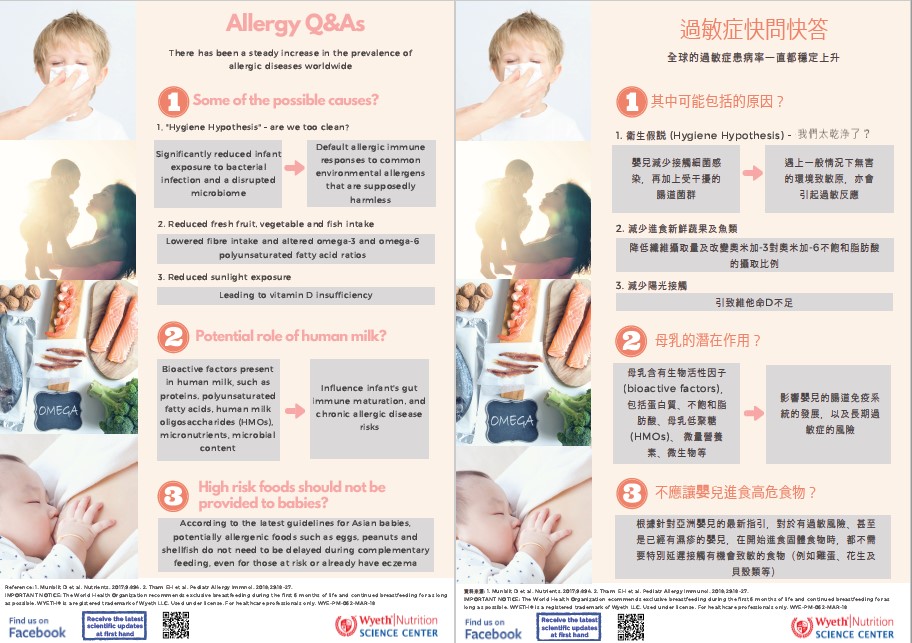
  • What is the latest suggestion on weaning and prevention of food allergy for Asian babies?
Download English PDF
allergy infographics

WYE-EM-095-MAR-18

If you liked this post you may also like

gut-puzzles
Article

[Literature library] Bovine milk oligosaccharides (MOS) support gut microbiota development and intestinal immune defense

[Guideline summary] Updated EAACI guideline on early life food allergy prevention
Article

[Guideline summary] Updated EAACI guideline on early life food allergy prevention

WNSC Hong Kong Bulletin 2021 Issue 1
Article

WNSC Hong Kong Bulletin 2021 Issue 1

Interview with Dr. Sean Austin and Dr. Norbert Sprenger: The diverse profile of human milk oligosaccharides (HMOs) and its significance in early life health outcomes
Article

Interview with Dr. Sean Austin and Dr. Norbert Sprenger: The diverse profile of human milk oligosaccharides (HMOs) and its significance in early life health outcomes

Home
IMPORTANT NOTICE

IMPORTANT NOTICE: We believe that breastfeeding is the ideal nutritional start for babies and we fully support the World Health Organizations recommendation of exclusive breastfeeding for the first six months of life followed by the introduction of adequate nutritious complementary foods along with continued breastfeeding up to two years of age. We also recognize that breastfeeding is not always an option for parents. If parents consider not to breastfeed, healthcare professionals should inform parents that such a decision can be difficult to reverse and that the introduction of partial bottle-feeding will reduce the supply of breast milk. Parents should consider the social and financial implications of the use of infant formula. Infant formula should always be prepared, used and stored as instructed on the label in order to avoid risks to a baby’s health.
 

  • Privacy Policy
  • Cookies Policy
  • Contact us
  • About WNSC
  • Accessibility statement

WYETH® is a registered trademark of Wyeth LLC. used under licence.

For healthcare professionals only.

© 2026 Wyeth (Hong Kong) Holding Company Limited. All rights reserved.
Scroll to top